From the Old Pyramid to the Numbers on a Team Sheet
Learn how football formation numbers grew from the old pyramid and how to read what those familiar digits reveal—and leave out—of a team’s shape.

Why does a team sheet show four defenders, three midfielders and three forwards when players spend much of a match elsewhere? Football formation numbers began as shorthand for a team’s starting arrangement, and their path from the old pyramid helps explain why they can look like a frozen snapshot.
The digits are not a universal code for tactical behaviour. They reflect changing ways of arranging players, including a major offside-law revision in 1925 that changed how many opponents had to be nearer the goal line for an attacker to be onside. Follow that history and the numbers become easier to read without mistaking them for a complete account of a team’s play.
What did the old pyramid describe?
In familiar formation notation, the goalkeeper is usually left out. The remaining numbers list outfield players by line, starting with defenders and moving toward forwards. A side with four defenders, four midfielders and two forwards is therefore written as 4-4-2.
That convention makes most sense against the early pyramid arrangement, commonly represented as 2-3-5. Two defenders stood behind three half-backs, who in turn supported five forwards. The shape narrowed toward the goalkeeper: two, then three, then five.
The labels described positions in an arrangement, not a promise that everyone would remain in a neat lane. Half-backs, for instance, stood between defence and attack, with responsibilities that could include marking opponents and helping moves forward. The pyramid tells us how a side was set out; it does not, by itself, explain every player’s decisions.
How did the 1925 offside change affect formations?
Before 1925, an attacker was generally onside only if at least three opponents were between the attacker and the goal line when the ball was played. The amended law reduced that requirement to two opponents. The goalkeeper commonly counted as one of them, so the change could leave an attacker onside with the goalkeeper and one other opponent between them and the goal line.
This was a specific change to the offside rule, not a command to add a defender. It made the old positioning of defenders riskier: a more advanced attacker could remain onside behind a thinner defensive line. Teams adapted their defending, and the change is associated with the move toward arrangements such as the W-M, often written 3-2-2-3 with the goalkeeper omitted.
In that arrangement, three defenders stood behind two half-backs, with two inside forwards and three other forwards ahead. The exact roles and movements varied; the notation records broad lines, not a complete tactical plan. Historical descriptions can also emphasize roles and relationships rather than list the players in rows.
How did the familiar 4-4-2 take shape?
Later arrangements made the back four a common reference point: two central defenders, with a fullback on either side. Ahead of them, a midfield line could contain four players, while two forwards led the attack. The resulting 4-4-2 became a recognisable shorthand because its lines were easy to identify on a team sheet and a pitch diagram.
That does not mean the formation was simply the pyramid with two players moved backward. Assignments and links between lines changed too. A fullback might support an attack; a wide midfielder might track an opposing runner; one forward might drop toward midfield while the other stayed higher. The numbers name the starting groups, but the match supplies the movement.
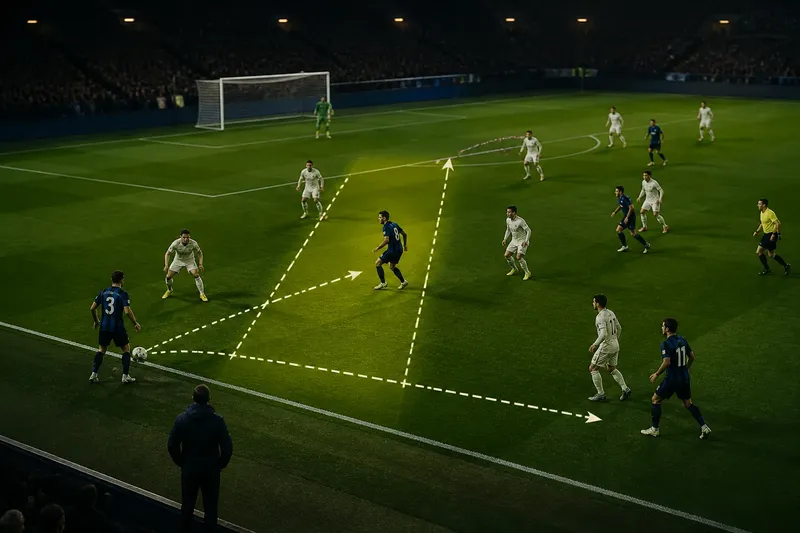
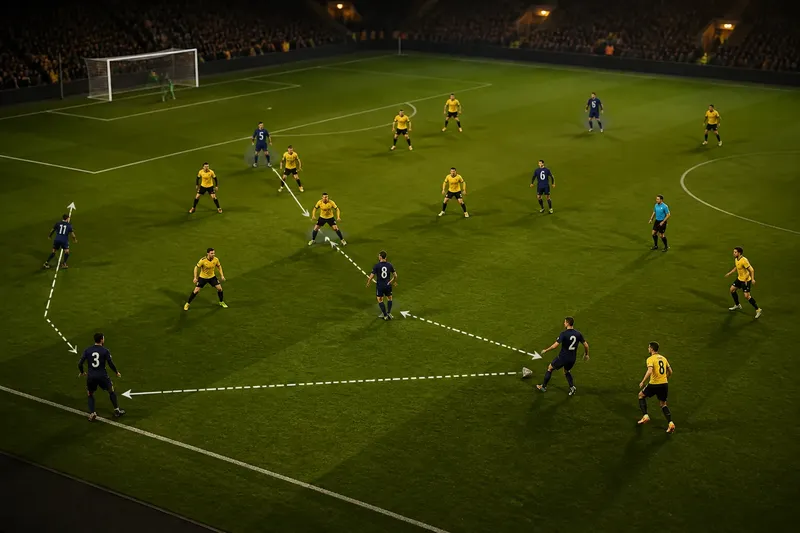
Imagine a coach listing a side as 4-4-2 and asking one forward to drop toward the ball during a build-up. The team sheet still says 4-4-2, while a view of that phase may show one forward near midfield and only one close to the opposing defenders. The label remains useful because it identifies the initial arrangement, not because it records every phase.
What do formation numbers tell you, and what do they omit?
The first number usually indicates defenders, followed by midfielders and forwards. A 4-3-3 signals four players in the defensive line, three in midfield and three toward the attack. A 3-5-2 points to three defenders, five midfielders and two forwards. The goalkeeper is not included in either sequence.
Those descriptions assume that players can be grouped into clear lines. Some shapes resist that neat reading. A side might have a lone player behind two forwards, or a midfield with a deeper player separated from the others. Different observers may choose different labels if they interpret those players’ positions differently.
The notation also leaves out width, distance between lines, pressing responsibilities and the direction a team wants to force an opponent. It cannot tell you whether a nominal wide player stays near the touchline, moves inside or helps a fullback defend. To see those details, watch where players stand as possession changes and how their teammates adjust.
Which formation-number questions do readers ask?
Does the goalkeeper count in a formation?
Usually not. A formation such as 4-3-3 counts the ten outfield players, with the goalkeeper understood separately.
Why are formation numbers written from defence to attack?
That order makes the lines easy to scan from the goal outward. It is a convention, not a description of the order in which players touch the ball or move during a match.
Can two teams have the same formation but play differently?
Yes. The same broad arrangement can support different pressing, passing and movement choices, depending on the players’ roles and the coach’s instructions.
Why do some diagrams use more than three numbers?
Some arrangements have a distinct line or a player positioned between the usual groups. An extra number can show that separation, though diagrams and commentators may describe the same arrangement in different ways.
How can you read the numbers on a team sheet?
Start with the listed lines as a map of the intended arrangement, then treat them as a clue rather than a tactical verdict. Check where the widest players begin, whether the central midfielders form one line or stagger themselves, and how many forwards are positioned high. Those details make a formation label more meaningful without demanding that it explain the whole game.
Say you are reading a fictional match sheet that lists a 4-3-3. First, count four defenders, three midfielders and three forwards, leaving the goalkeeper outside the sequence. Next, watch the opening phase: suppose one midfielder drops between the centre-backs while both fullbacks move forward. The starting answer remains 4-3-3, but the observed build-up has a deeper midfielder and a wider, more advanced pair of fullbacks; that distinction is more useful than replacing the team-sheet label after one movement.
For historical comparison, keep the same questions in mind. The pyramid’s 2-3-5 puts five players in the forward line; the later 4-4-2 has a deeper back line and fewer players listed as forwards. That contrast captures a shift in how teams arranged their outfield players, even though notation cannot convey all the work those players did.
What is not worth the effort is treating every change in a broadcast graphic as proof that a team has adopted an entirely new system. A player may shift position for a brief phase while the underlying arrangement remains recognisable. The useful question is whether the team’s lines and roles have changed in a sustained way.
Football formation numbers make the history of team shape legible by compressing a side into a few rows. From the old pyramid to a modern team sheet, they record broad changes in how outfield players are arranged. Read the digits as a starting picture, then watch the movement that fills in what they cannot say.