The Half-Space: Where the Lines Leave Room
The football half-space helps attackers connect the centre and wing; learn how to read its passing options, time a run and spot when the lane is crowded.
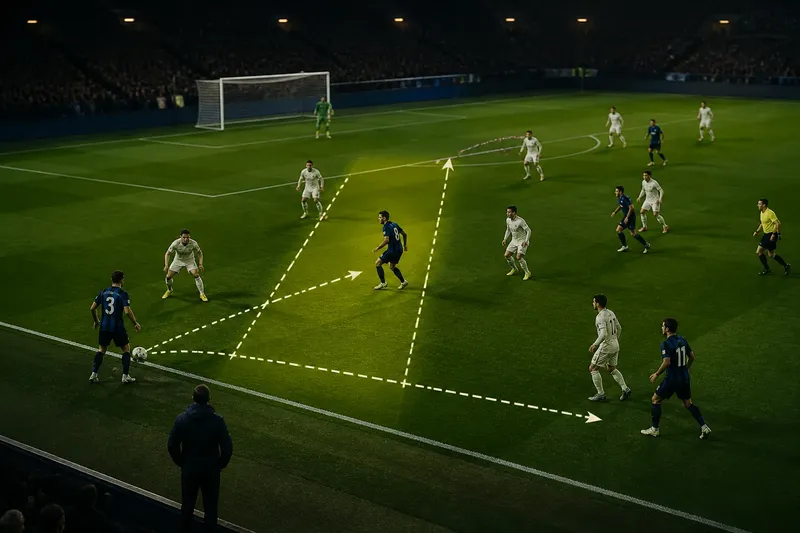
Where can an attacker receive between the centre and the wing without blocking a teammate’s route? The football half-space offers that in-between lane, but its value depends on who is nearby, which way the receiver is facing and what the defenders do next.
How does the football half-space open passing options?
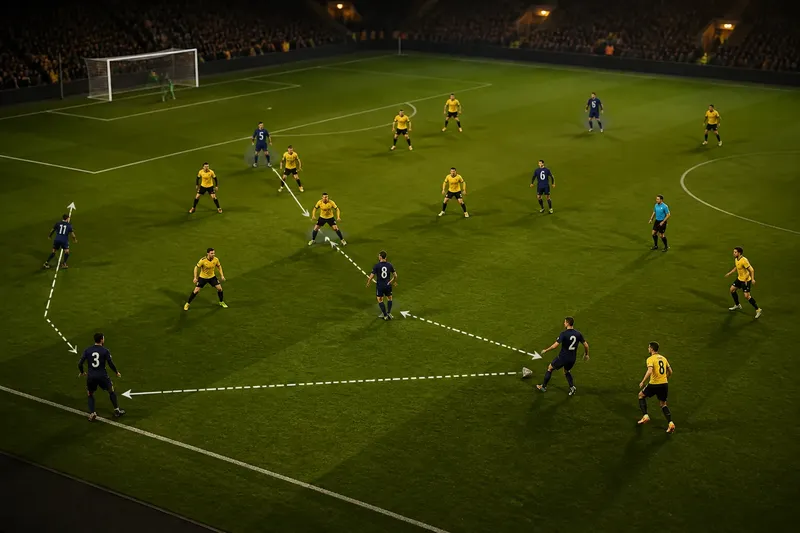
A defender in this lane can draw attention from both a centre-back and a fullback. If one steps toward the receiver, space may open for the striker or winger; if neither steps, the receiver may have time to turn. Neither response is automatic: the pass and the supporting movement still have to arrive at the right moment.
The lane also offers a diagonal route from a teammate in the centre or on the flank. Once the ball reaches the receiver, a pass can go back inside, out to a winger or forward toward a striker. That range of choices can make the next defensive assignment less obvious than a pass received beside the touchline.
It can also help connect players who would otherwise be separated. A winger holding width can keep a fullback occupied, while a midfielder moves inside to receive. If the winger instead cuts in, an overlapping fullback may provide the outside route. The useful position shifts with the attack rather than belonging to one fixed spot.
What should a player do before and after receiving?
Before the pass arrives, scan for pressure and support: check whether a defender is close, whether the striker is available and whether a teammate is keeping the flank open. Open body shape toward the far side can make it easier to see both an inside pass and an option out wide. If pressure blocks the turn, a controlled layoff may keep the attack moving.
Time the movement to the ball-carrier’s action. Arriving as a teammate advances toward the defence may make the lane harder to track; standing there too early can give defenders time to close it. The runner should also notice whether another attacker is already moving into the same space.
Say a team is building on the left: its winger stays wide, its striker occupies the centre-backs, and a midfielder moves into the left half-space as the fullback carries the ball forward. If the opposing fullback stays with the winger, the midfielder may be available inside. If that defender narrows toward the midfielder, the winger may have room outside. The observable result is a choice for the defender; it does not promise a chance or a completed pass.
What should you watch for when a team attacks there?
Is the half-space the same as the wing?
No. The wing is the wider lane beside the touchline, while the half-space lies between it and the centre. An attacker may move from one lane to the other during the same move.
Can different players use the half-space?
Yes. A midfielder may receive between the lines, a winger may drift inside, or a striker may move across to combine. The role depends on the team’s shape and the positions of nearby teammates.
Why do attacks use the half-space near goal?
A receiver there may combine with a striker, pass toward a winger or carry the ball toward goal. Defenders must account for both an inside action and a possible pass toward the flank.
How can a viewer spot a useful run?
Watch the runner in relation to the nearest centre-back and fullback, then check whether the ball-carrier has a route to pass. The run is useful if it draws a defender or opens a route for a teammate, even when the runner does not receive the ball.
When is the half-space too crowded?
If the opposing midfield and defence stay compact, a pass inside may reach a player with little room to turn and no nearby support. The attack can instead circulate the ball, move the defensive block across, or use the winger before trying the inside route again.
Watch for teammates converging on the same lane. If a winger cuts inside while a midfielder also moves there, the outside channel may be left empty. The team may need the winger to hold width or the midfielder to delay the run, depending on where the ball is and how the defenders are positioned.
- If the receiver can see a teammate inside and one outside, choose the route that is open; if both are covered, return the ball to support and reset the attack.
- If a defender steps toward the receiver, check whether the striker or winger is free; if neither is available, protect the ball and play back rather than forcing a pass.
- If the winger holds the touchline, check whether the inside lane is open for a midfielder; if the lane is occupied, let the midfielder stay behind the ball and support possession.
- If the receiver is facing away from goal under close pressure, check for a safe layoff; if the return pass is blocked, shield the ball and wait for support rather than turning into pressure.
- If the opponent keeps the centre compact, check whether the wide player has room; if the flank is also closed, circulate the ball to shift the defence before attempting another forward pass.
- If two attackers move into the same half-space, check which player can offer the better passing angle; if neither can separate, one should hold a different lane to preserve an outlet.
Exact boundaries are not worth arguing over: coaches and analysts may divide the pitch into channels differently, and the team’s shape changes how those lanes appear. For watching a match, focus instead on which defender moves, who remains available and what passing route opens next.
Next time a team attacks down one side, follow the player between the centre and the winger, not only the ball. The football half-space is most revealing when you notice the choice it presents to a defender—and whether the attack has a safe option if that choice closes the first route.