How to Read a Football Player’s Role by Following Their Choices
Learn how to read a football player’s role by tracking their choices, responsibilities and relationships with teammates without trying to follow the whole team.
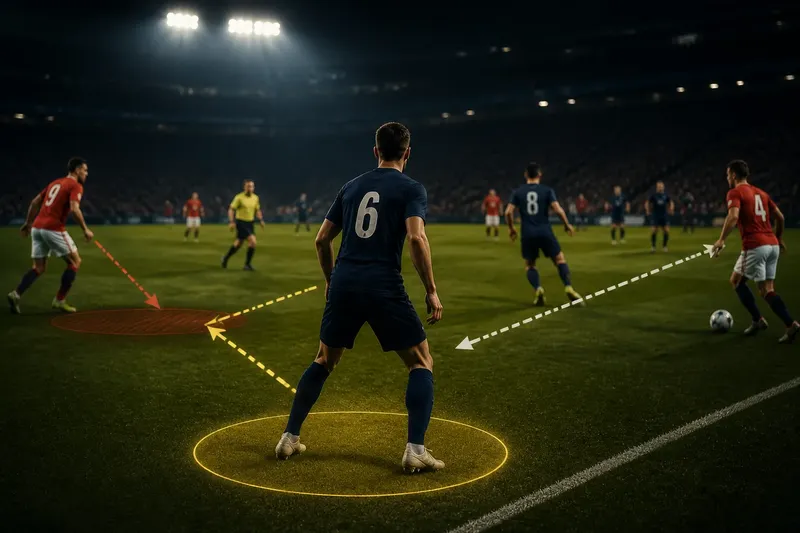
To read a football player’s role, follow the choices they make around teammates—not just the patch of grass they occupy. A central midfielder can look like a different player when asked to screen a pass, support a buildup or offer an outlet under pressure. Track those choices and you can see the job behind the position.
This method is about responsibility and relationships, not formation diagrams or a running account of every possession. Choose one player, identify the problem their team faces, and watch how they respond.
Which role gives you the clearest choices to watch?
Start with a player whose decisions affect nearby teammates. A full-back, central midfielder or centre-forward each offers a different view of the team’s priorities.
- Choose a full-back if you want to see how a team handles an opposing winger. Watch whether the full-back steps out to engage, stays deeper to protect space behind, or relies on a teammate to help.
- Choose a central midfielder if you want to understand how the team protects its centre. Notice which passing lanes the player screens and whether they move to support a teammate under pressure.
- Choose a centre-forward if you want to see how the team directs its pressure. Watch which opponent the forward approaches and whether that run makes a particular pass harder.
Pick a player who stays visible through several passages. You do not need to decide their exact position before watching; the recurring assignment is more revealing than a label.
How can you tell what responsibility a player has?
Look for the problem the player appears to solve. Are they preventing a pass into an opponent, giving a teammate a safe outlet, guarding space behind another defender, or drawing a marker away from a useful area? Their relationship to the nearest opponents and teammates often answers more than their distance from the ball.
Compare what the player does in similar situations. A midfielder who repeatedly shifts across to stand between the ball and an opposing playmaker may be protecting the central route. A full-back who delays an attacker until a teammate can recover may be prioritising containment over an immediate tackle.
Keep the description tied to what you can see. “Moves across to block the pass into the striker” is a useful observation; “is the team’s tactical leader” is a conclusion you cannot establish from that movement alone.
What decisions matter when the ball is elsewhere?
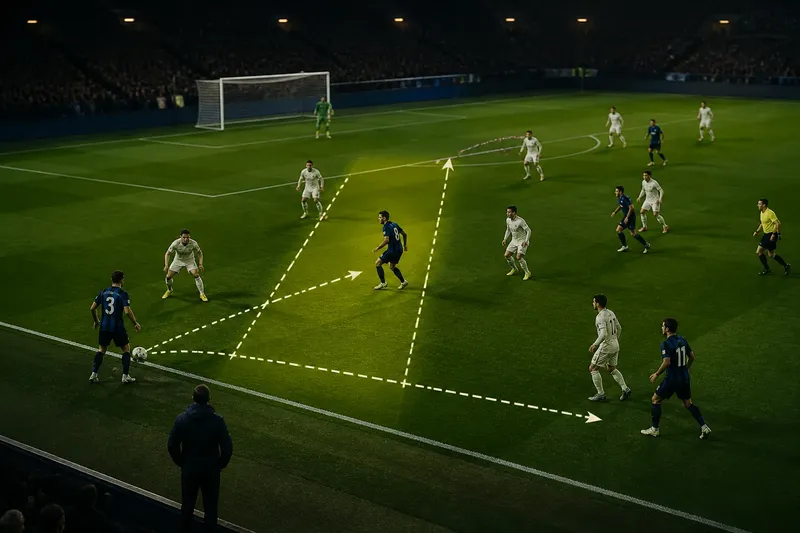
Watch the player when a teammate has the ball or when an opponent is preparing to receive it. A centre-forward may angle a run to steer the opponent toward one side. A winger may stay close to a full-back to limit an easy pass. A midfielder can hold a position that discourages a forward pass even without touching the ball.
Notice who adjusts around the player. If a defender steps forward, does the midfielder drop into the space left behind? If a winger moves inward, does the full-back stay wide or follow? These linked movements help distinguish an individual habit from a shared assignment.
Imagine you are watching a holding midfielder as the opposing centre-back carries the ball forward. The midfielder first stands between that defender and an opposing striker; when a teammate presses, the midfielder shifts toward the passing lane to the striker. The observable result is that the defender must look elsewhere or attempt a more difficult pass. That sequence suggests the midfielder is protecting access through the middle, not merely standing near the centre circle.
How should you read a player’s choices under pressure?
Pressure makes priorities easier to spot. When a teammate is crowded, check whether the player moves close enough to offer a pass, stays in a position that protects against a counterattack, or draws an opponent away to open another route. None is automatically the right answer; the team’s spacing and the danger around the ball matter.
For a defender, watch whether they engage the ball-carrier or hold their ground to protect a teammate. For an attacker, notice whether they receive with their back to goal, turn toward space, or pass quickly to keep the move alive. The useful question is what option their action creates or removes.
What questions help you identify a player’s role?
Is a player’s position the same as their role?
Position describes where a player is arranged; role describes the responsibilities and decisions that recur in that arrangement. A wide defender, for example, may be asked to press an opponent, cover a teammate or provide an attacking outlet in different situations.
How can you separate a team instruction from an individual choice?
Look for the same response in comparable moments and check whether nearby teammates move in coordination. One isolated action could be a reaction to an unusual situation, while a repeated, connected pattern is stronger evidence of an assignment.
What if a player’s decisions seem inconsistent?
Check what changed: the opponent’s position, a teammate’s movement, the score pressure or the location of the ball. If the conditions differ, the player may be adapting rather than abandoning a role.
Should you judge a role by its most visible action?
No. A tackle or forward run stands out, but quieter choices—screening a pass, holding a line or offering an outlet—can explain why that action was possible. Track the setup as well as the moment that attracts attention.
How can you keep notes that lead to a sound reading?
Use a short observation and a decision, rather than a verdict. The following checklist keeps each note tied to something visible:
- Check the nearest passing lane: If the player repeatedly blocks a route into an opponent, infer that screening may be part of the assignment; if not, check whether they are marking a specific player instead.
- Check the player’s response to a teammate under pressure: If they move into a clear passing angle, note an outlet responsibility; if they stay away, check whether their position protects a more dangerous space.
- Check what happens when a teammate steps forward: If the player fills the space behind, note a covering responsibility; if they move elsewhere, look for another teammate providing cover.
- Check how the player approaches an opponent with the ball: If they close from an angle that limits one direction, note an effort to steer play; if they approach directly, check whether a teammate is covering the route they leave open.
- Check whether a run changes an opponent’s position: If a marker follows and leaves space, note a decoy or space-creating movement; if the marker stays put, consider whether the run is intended to receive the ball instead.
- Check whether the same response appears in comparable situations: If it repeats with similar teammates and opponents nearby, treat it as a likely habit; if it does not, record the different conditions before drawing a conclusion.
Say you are following a right winger. In two observed situations, the opposing left-back receives the ball while the winger’s full-back is still recovering. Each time, the winger approaches from the inside and leaves the pass down the touchline available. You note the starting positions, then check whether a central midfielder is covering the touchline route. If that midfielder shifts across on both occasions, your cautious reading is that the winger’s approach helps steer play inward while the midfielder provides cover; if the midfielder stays central, the winger may instead be prioritising the route into the middle. The notes identify a possible shared responsibility without pretending that two moments settle the question.
When should you follow a teammate instead?
Switch once you can describe the first player’s recurring choices and want to understand how another role supports or responds to them. After watching a centre-forward direct pressure, follow the midfielder behind them: does that player close the passing lane the forward’s run leaves exposed? After watching a full-back delay a winger, follow the covering defender: do they protect the space behind?
What is not worth the effort is assigning a tactical label to every touch or keeping a tally of every pass. Those records can crowd out the more useful question: what responsibility was the player trying to carry out, and what did teammates do in response?
To read a football player’s role with confidence, look for repeated choices in comparable situations, then check how teammates fit around them. The most revealing action may be the quiet one that lets another player take the obvious risk.